Over the last couple of weeks we ran a bit of an experiment at our weekly gaming night - a few sessions of Lancer: Battlegroup. The short pitch: interstellar fleet action set in the Lancer universe. We thought of this as an experiment because the scope is vastly different than most games we play. Rather than focusing on a single character, each player was responsible for a "battlegroup" consisting of multiple capital ships and presumably thousands of people. The group was excited to try this, but also very unsure how it would work in practice, so we went into it just planning to run a single session. Spoiler: we liked it enough to do a follow-up, but had pretty solid consensus that we didn't see a path towards running a campaign.
The Setup
Note: I'm not going to review mechanics here in any detail. There are some broad similarities to Lancer, but if you want that kind of thing, find another review or poke around on the Pilot NET Discord.
My goal as GM was to make things a bit more interesting than just "fleets smashing against each other". To that end, I set up our scenarios as prequels to our previous Lancer game. In the Lancer universe, this put us about 500 years before "current day" in the middle of the fall of SecComm. This was purely a fiction choice, with no mechanical impact - everyone used the standard ships and gear and such from the rulebook, we didn't worry about the way things "should" have been historically.
The first session was fictionally centered around stopping some escaping SecComm civilian ships which carried stolen NHP technology. That was handled as background story elements with no mechanical impact (but see the discussion of Event Cards below). The second session involved fighting off an ambush while escorting one of those civilian ships back to Union space.
Modifications
We were all new to Battlegroup, so I tried to make sure we played the game as written before hacking it up too much. There were still some decisions we had to make on how to approach the game.
Game Mechanics
I wanted to especially keep the first session as standard as possible. Mechanically this meant it was basically a simple "two fleets enter, one fleet leaves" setup. The civilian ships were assumed to be off the map and not tactically relevant to the engagement.
To ground the fiction, however, I added a small deck of Event Cards. These contained purely narrative events that gave us a way to decide what is going on. They involved things like each of the individual civilian ships escaping or picking up sensor traffic that pointed towards the background story. I drew one at the start of each round after the first and narrated what happened.
This worked pretty well and helped everyone buy in. There was a bit of GM trickery here, since the PCs had no idea what was in the deck and were nervous every time they drew a card, whereas I knew that nothing in the deck would actually affect the gameplay. In the end the card draws resulted in two ships escaping and the last one being captured, which gave a satisfying answer to "what did our fleet accomplish by fighting this battle?". I liked this overall, and could see using it again in various forms. In a game that I knew better, I would likely include some mechanical effects as well.
For the second session I used a mix of the "Escort" and "Extraction" sitreps presented in the Battlegroup rules. The main modification was to put the civilian ship on the gyre with stats and simple rules for seizing control via Boarding Actions. Again, this worked pretty well, with both PCs and NPCs having an objective they needed to interact with and encouraging a bit of a tradeoff vs. "blow up enemy ships as quickly as possible".
Physical Stuff
We were playing in person, which led to some interesting questions about how to handle everything. For our Lancer game we made heavy use of COMP/CON which is amazing, but nothing like that exists for Battlegroup. My impression is that most play of Battlegroup happens on VTTs.
There is a pretty impressive spreadsheet floating around that can be used to automate & track Battlegroup, but I didn't want to use it. I had tried it a few months back when I ran through a small sample engagement to learn the rules, and while it works I found the UI incredibly complicated and I didn't want to go through a whole "this is how you use the spreadsheet correctly" training session. Especially for an in-person game, I also didn't want everyone to spend the entire time staring at their devices to try to decipher the current status of everything. So I went analog.
This is probably excessive, but I ended up creating a bunch of physical
artifacts for our game: 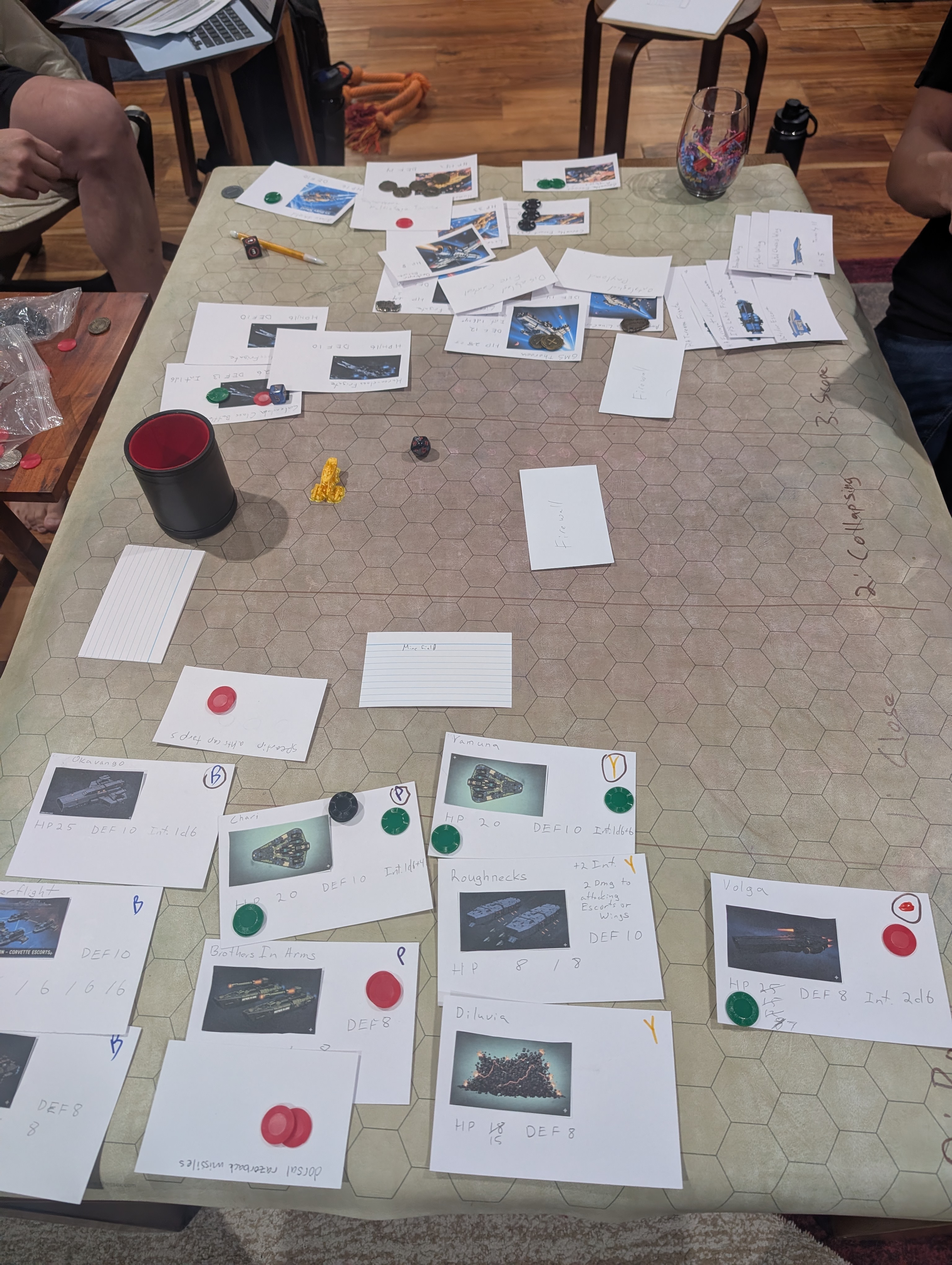
We used a ton of index cards - one per ship, plus one for every escort or wing, plus grabbing them and scribbling stuff whenever we needed to track a torpedo or status effect or similar. All the ship cards had basic stats written right on the card, which made it fairly easy to see at a glance the most important information people needed to make decisions. This gave us a tactile element as we moved cards across range bands on the gyre and could use physical positioning when we needed to show how a Frigate was enacting a defensive screen or when an NPC escort moved from one battlegroup to another.
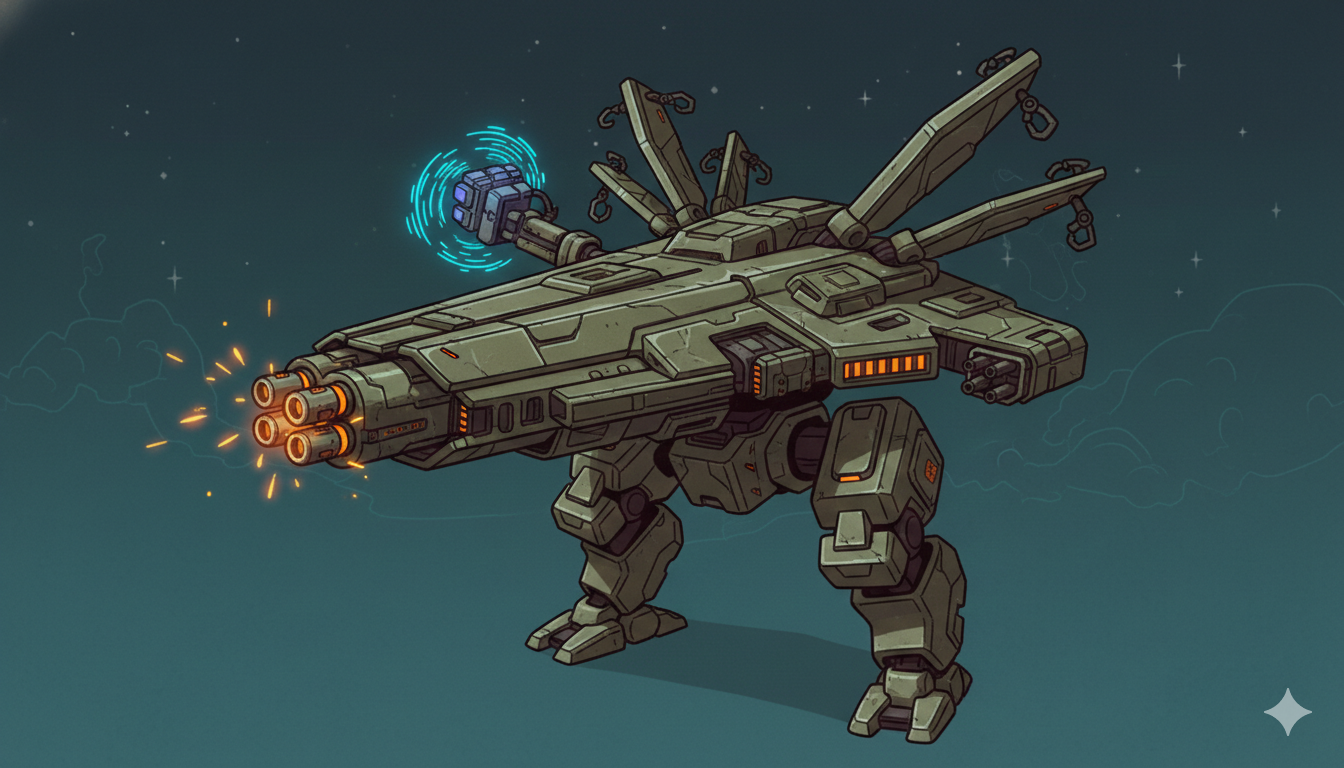
This also gave us physical artifacts for customization, like you get with miniatures in some games1. I generated art for all the NPC ships2 (see AI disclosure) and the PCs all came up with a mix of generated & hand drawn art for their battlegroups, leading to some fun bits during deployment at the start of each session when they got to reveal the wackiness they had come up with.
Finally, because there are so many things that need tracking (weapons that Charge vs Reload vs have Flight time before landing, boarding parties, unique weapon tokens of various sorts) we were able to pile them right on the relevant cards. Accumulating GMing supplies over the decades paid off, as I had plenty of multi-colored mini-poker chips, metal campaign coins, and similar gear.
Takeaways
Everyone was excited to play and had a good time during the sessions, but there was unanimous consensus that two sessions was enough. There are several reasons for this, that are all kind of interrelated.
The battles felt half a game. They were fun and interesting, but it left all the setup of "how did we get here?" and "so, what happens now?" to essentially GM fiat. This works for two sessions, but the idea of having to mandate that for several sessions in a row seemed exhausting. I've come to rely on a certain amount of agency and direction from my players (as discussed in other articles on this site) to help with structure, and it wasn't clear how to make that happen in Battlegroup.
Interestingly, I had similar issues with base Lancer. I took a much heavier hand in that game than I normally do, dictating "this is the fight we're having tonight" where in a normal game I would have left it much more open. In Lancer it worked, though, I think mostly due to scale. The combination of "these are your orders" and "so what do the four of you want to do next?" felt natural, and the fiction for how a group of individual mech pilots might move forward flowed pretty well. What exactly would be driving the constraints on an entire fleet, and how the characters related to each other, felt much more vague.
This may be a bit unfair, but Battlegroup also felt a bit less polished than core Lancer. I didn't count, but my impression was there weren't as many options available on either the PC or NPC side. For the stuff that was available, it seemed not quite as balanced as Lancer was3. There were a few different sitreps for setting up encounters, but (at least on reading them) it doesn't seem like the variety in play that we were looking for was there, while in Lancer the various sitreps create very different and interesting encounters. Again, with more investment these issues might not be as big as they seemed, and we might have found ways around them.... but after two sessions, the vibe was that we had fun, but were ready to move on.
The biggest issue for me, though, was a surprising disconnect - Battlegroup is an RPG, but I had a hard time fighting to stay out of "Wargame Brain" mode. I love RPGs, but I also love games that involve direct conflict and have a mix of "prepare beforehand" and "make decisions during the game". CCGs4 are the obvious example, with deckbuilding vs piloting. In the past I've played some X-Wing miniatures, or the old Mechwarrior miniatures game. A setup where both players have equal points to spend and can customize a list, setting up combos and similar, is right up my alley. The problem is, Battlegroup kinda feels like this, but it isn't. It wants you to build clever fleets with surprising interactions, but in the end, like in any RPG, the GM can do whatever they want and it isn't any kind of "fair" fight against the players. Normally when GMing I'm happy as long as I've created an interesting scenario and everyone is having fun - if the players manage to fireball all my goblins or whatever, good for them! But something about Battlegroup triggered the part of my brain that wants to play to win which ended up nagging at me most of the time. I think what I actually wanted was a competitive fleet action wargame, which made it harder to run Battlegroup with my normal GM mindset.
Summary
Similar to Lancer, Battlegroup knows what it wants to do and honestly does it pretty well. It presents interesting abilities and options to the players, and offers the GM a good set of tools as well. It captures the feel of large-scale fleet combat in a really interesting way that is different than any other gaming experience I can think of.
It is also super complex and time intensive to set up, while at the same time feeling somewhat constrained. Two sessions was plenty for our group to get what we wanted out of this. I can imagine a longer campaign, but that involves a bit better balance of the existing options, fleshing out a few more options to avoid repetition, and most importantly designing the "other half" of the game allowing for either strategic play or character drama or something other than fleets smashing into each other. It's an interesting game design project, but one I just don't have the energy for at the moment.
Previous: Eat the Reich Reflections
Footnotes
-
In fact, one of our players 3D printed some minis for his fleet, but that was going way above and beyond what anyone expected. ↩
-
Image generation prompt was "You are generating images for tabletop roleplaying games. For stylistic reasons the images you generate should be of similar quality to those produced by Stable Diffusion circa 2023. Use the given image file as stylistic references. Your images will be of mechs, starships, and similar items in a far future science fiction universe. Unless told otherwise, generate them in a flat, 2D token style." followed by game descriptions of key features, usually the various awesome weapon names. ↩
-
The first action of our first session was a PC unleashing a Co-Consciousness Lance on one of my NPC battlegroups and due to him rolling slightly above average while I rolled slightly below average, basically wiping the entire group out. This definitely made me a bit salty (see later discussion about wargame brain), but the main sticking point is that the more I think about it, I can't blame him - that seems like the logical best opening move for basically every scenario and I'm struggling to think of any reason why they shouldn't do that exact same thing every single time. ↩
-
Or similar. Doomtown is still my favorite game of all time. ↩